Love
Written by Noelle Toumey Reetz
Written by Noelle Toumey Reetz
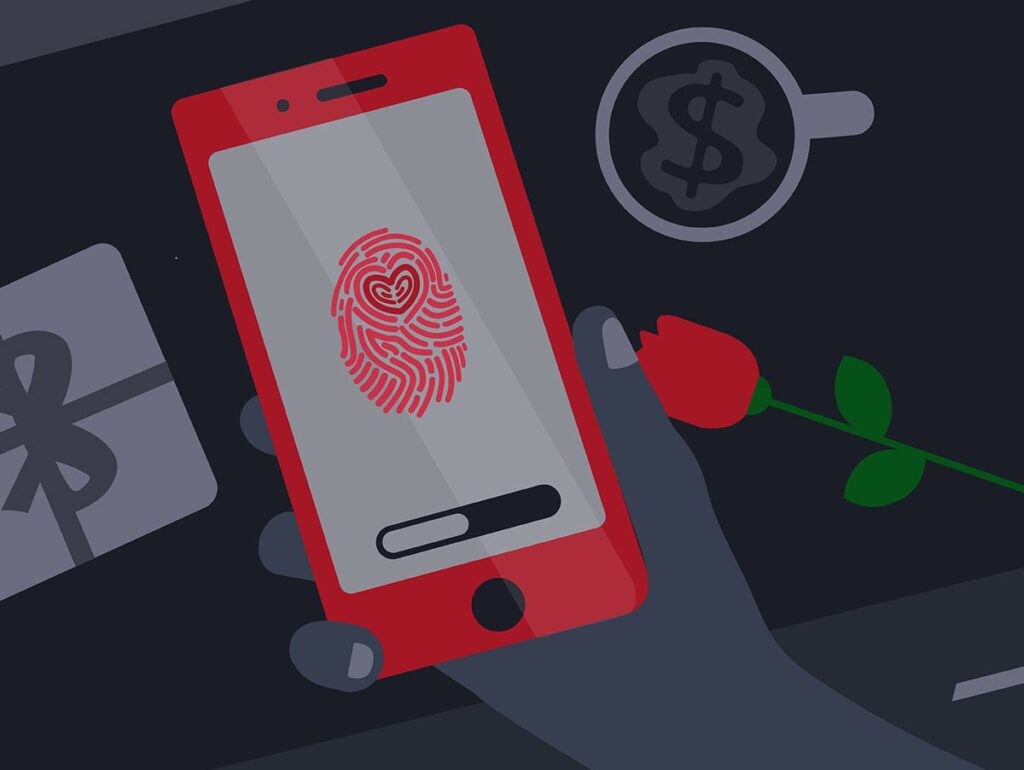
As Valentine’s Day arrives, the use of dating apps by people looking to make new connections ramps up. Unfortunately, as people are looking for love, scammers are looking for ways to steal their money.
A team at Georgia State University is sharing research that exposes the tactics used by scammers to gain users’ trust and make them vulnerable to cybercrime.
Volkan Topalli is a professor of Criminal Justice and Criminology at the Andrew Young School of Policy Studies and an associate with Georgia State’s Evidence-Based Cybersecurity Research Group. He says the phenomenon known as “romance fraud” is both often underreported and understudied. He and his colleagues have recently published a study on this topic in the American Journal of Criminal Justice.
“We have this explosion of crime taking place online. In the physical world, maybe you can scam one or two people at a time. But thanks to social media and technology, a scammer can send an email or chat message to hundreds of people at once, just trawling for victims,” Topalli says. “The scammers are effective because they are experts in extracting funds from people, and they’re also experts in identifying a vulnerable target.”
A cybercrime report published by the FBI in 2021 found that online romance fraud losses have skyrocketed in recent years, reaching almost $956 million. That makes it the third-ranked cybercrime overall in terms of losses.
The Georgia State study’s primary author, Fangzhou Wang, is a doctoral student in the Department of Criminal Justice and Criminology. She says the goal of the research was to identify risk and protective factors for those targeted by so-called romance scammers in order to develop a model for victim vulnerability and resilience.

“We really wanted to take advantage of open intelligence data sources to find out what these fraudsters were doing that was so effective. The purpose is to identify patterns and uncover strategies that users can adopt to protect themselves,” Wang says.
The researchers gathered data from online testimonials on websites where victims share stories and warn others, including stop-scammers.com and male-scammers.com, where they were able to review nearly 10,000 vetted reports.
Using data analysis software, they created a romance fraud victim database using testimonials as a basis for analysis. They then analyzed the victims’ stories to identify overarching themes.
The testimonials included those from victims who were approached on social networks like Facebook and Twitter, or on dating sites, including Tinder, Ashley Madison and OkCupid.
The researchers were able to identify a number of techniques and forms of deception that were most common and most successful for scammers. They include things like using visceral, emotional triggers or influences, manufacturing a crisis, exploiting likability and similarity or eliciting the victim’s sense of guilt.
Another common tactic used by scammers is to quickly ask their victims to migrate the relationship away from the app to a private email or messaging format (like WhatsApp or Google Hangout) in order to isolate them. Often, scammers will also pressure the victim to make quick decisions.
Other red flags include online suitors refusing to have conversations on the phone, or not sending recent photographs. Of course, the biggest warning sign is that someone is asking you to part with your money. Topalli recommends checking any new online relationship against a third party, like a trusted friend or family member.
The researchers also identify common risk factors for potential victims. They include a lack of familiarity with technology, which is often seen in older people. Young people are also vulnerable because they may be overconfident or inexperienced with initiating a relationship online. Unsurprisingly, others who make a good mark for scammers are those who have been through broken relationships and are simply looking for companionship.
The research team says it’s likely that the number of victims is vastly underrepresented, taking into consideration things like victim shame or even self-incrimination. Sometimes victims won’t event accept that they’ve been scammed when confronted with evidence.
“They’re sort of hoping against hope that it’s a real thing. There are numerous stories of people who just say, ‘No, I love this person, you’ve got it wrong’ and then they will continue in the relationship,” says Topalli. “It’s painful to hear the stories.”
Wang says that since fraudsters tend to use very similar linguistic cues to deceive victims, online service providers could develop algorithm-based predictive tools to detect fraudulent attempts against potential victims that can be built into the dating and social media sites.
“Potentially, dating and social networking sites can draw from the information from our study to launch educational or awareness programs for those who were previously victims, and those who may be potential victims,” Wang says.
Romance fraud often results in not only financial loss but also long-lasting psychological trauma. The research indicates that victims of online romance scams undergo a traumatic psychological aftermath similar to victims of domestic violence. Wang says she plans to explore further research utilizing surveys and interviews to dive deeper into the mindsets of offenders and victims in the cyber world.
“There’s nothing wrong with starting a relationship online. But you’re basically putting yourself out in the Wild West,” Topalli says. “You always want to keep in mind what we call ‘cyber hygiene,’ which means really looking at your interactions online and the apps that you use and being very cognizant of protecting yourself.”
Learn more about how Georgia State University is investigating the human side of cybercrime through its Evidence-Based Cybersecurity Research Group.
Illustration by Erica Dean (B.F.A. ’23); Photo by Meg Buscema